... now with 35% more arrogance!

Monday, September 8, 2025

No Mapping, Just Map Rolls

Back in my post about why players might map and why they should be allowed to choose not to map, I teased “there may be ways to maintain that element of player choice without requiring an actual map.”

I have an idea.

Map Skill vs. Minimalist Maps

Chaosium’s Stormbringer, unless I’m remembering incorrectly, had a Map skill. The GM would roll percentile dice vs. Map skill to see if players make it to their destination. We could use the Int ability score in a similar way. It still feels too bland to me, so I would repurpose the reaction roll (again!) and break the trip to any destination into stages.

Players could (should?) still make simple maps, but only to show which areas of a dungeon are connected. Each area would be represented by one box each, regardless of how many rooms are in each area and where they are in relation to other rooms. The areas are labeled “outer gates”, “crypts”, “treasure vaults”, “prison”, “library”, “caves”, “fungus farms”, or whatever the function or theme of that area is. Each pair of boxes is either connected (draw one line connecting them) or not connected (no line.) No individual tunnels are marked.

If the players have a map and are looking for the exit, they would follow the lines from box to box, with the GM making a reaction roll for each transition to the next area: treasure vaults to crypts, crypts to outer gates, and outer gates to exit would require three rolls.

Map Use Result Table

If the map roll is less than or equal to the Int of the character using the map, use the “Map Success” column for the result. If the roll is higher than Int, use the “Map Failure” column. Halve the Int score if the map is damaged or otherwise incomplete, or if the character is drunk, befuddled, or otherwise inconvenienced.

2d6 Roll Map Success Map Failure
2 3x time to reach next area lost in new (unmapped) area
3-5 1.5x time to reach next area lost in random area
6-8 normal time to reach next area lost in previous area
9-11 half time to reach next area stuck in same area
12+ half time, no wandering monster rolls 5x time to reach next area

Maps Made by Other People

The steps above assume the character reading the map also created the map. If not, the GM needs to know both the Int of the map maker (or assign it randomly) and the Int of the character using the map. Roll against the lower of the two scores when using the map.

The character using the map can substitute their Wisdom if it is higher than their Int, but only when using a map they didn’t make themselves. If the map has a lower Int rating than either, however, it’s not going to help.

When buying a map, make a reaction roll to check if the map is a lie (odd rolls below a certain threshold.) These maps automatically are treated as half Int.

Creative Commons license

This work is licensed under a Creative Commons
Attribution-NonCommercial-ShareAlike 4.0
International

(CC BY-NC-SA 4.0) license.

Thursday, September 4, 2025

Non-Human Races in Fantasy Lit

We all know that Tolkien invented the idea of non-human races in fantasy fiction, which in turn influenced D&D and other RPGs by bringing us the standard fantasy races of elf, dwarf, halfling, and orc/goblin. Before Tolkien, fantasy writers either focused on human characters only, especially in swords & sorcery, or they only used non-humans as monsters, fantastic beasts, mentors, or supernatural messengers.

But … do we really know that?

Someone’s question about swords & sorcery RPGs got me thinking about this.

For the Kiddies

Let’s start with the idea of human characters as the focus, with non-humans only appearing as mentors, messengers, or monsters. Or, to put it in RPG terms, humans are the only “PC race”, with things like goblins as “NPC only”. This seems to be mostly true of European fantasy written for children… except that there’s a lot of cases of talking animals, goblins and other “cute” monsters, or children transformed into dragons or other creatures that become companions or allies to human beings.

The best-known example, though not the oldest, is C. S. Lewis’s Chronicles of Narnia. In the very first book, we have the fauns (Tumnus,) the talking beavers, and the centaurs. In later Narnia books, the Marsh-wiggles and the Dufflepuds show up as “original” fantasy races, although we could argue that Dufflepuds are just a variant of dwarves, which also show up in Narnia.

Some of the characters in Baum’s Oz books are unique rather than belonging to a “race” (Tin Woodsman, Scarecrow,) but we have loads of talking animal characters and odd races like the Quadlings.

Lewis Carroll’s books are definitely swarming with creatures that are treated no differently than human characters. I actually used to have a write-up for “Cheshire cat” as a playable race (although really, it was the Cheshire cat crossed with Puss in Boots.)

Weird Sorcery

In contrast, weird tales and swords & sorcery do in fact tend to focus on human characters only. Non-human “races” do exist, but are usually treated as antagonists or monsters. They are the challenge for a specific story, or the surprise at the end. They rarely reappear. We do have serpent-folk showing up in Clark Ashton Smith’s “The Seven Geases” or Robert E. Howard’s King Kull stories, hairy humanoids like Smith’s Voormis, or Lovecraft’s fish people (frog people?) in “The Doom That Came to Sarnath”.

Since all of these writers are pre-Tolkien and therefor could not be influenced by Tolkien, this might seem to support the theory that pulp fantasy, at least, did not have anything that could be considered a “playable race” when translated into an RPG. But while none of these authors read Tolkien, they did read Arthurian legend. We do see something similar to the Fae or elves in some weird fiction. Earliest I can think of is A. Merritt’s “The Women of the Wood”, where the fae-like people of the wood act more like the “surprise” mentioned earlier. Much later, though, Roger Zelazny’s Dilvish the Damned describes Dilvish as having a little elf-blood, and Dilvish has memories of a visit to his distant elven relatives.

But the more famous example of elves in swords & sorcery would be the Melnibonéans from Michael Moorcock’s Elric saga. Melnibonéans are basically evil elves, and in some of the stories where Elric is transported to other worlds, he’s called an elf by other characters.

Back to the Worms

In addition to Arthurian legend, though, the old pulp fantasy writers and even Tolkien had another influence: E. R. Eddison. His classic novel The Worm Ouroboros has demons, witches, goblins, and pixies as main characters. The demons have small horns, the “races” don’t have any recognizable features that I recall, although I believe Lord Gro (the goblin) is said to be shorter than the others, so maybe that’s a racial feature.

You could argue, then, that these “races” aren’t fantastic non-humans or even variant humans, but just people living in various countries. This could, in fact, be one reason why swords & sorcery has a lot of human races, but seemingly no non-human races except in opposition to humanity as menaces. But both C. S. Lewis and J. R. R. Tolkien read The Worm Ouroboros, too. Which leads to my big question…

Are Tolkien’s Races Non-Human?

Post-Tolkien fantasy and fantasy RPGs, including D&D, consider elves, dwarves, halflings, and orcs to be non-human. Most people would probably say that’s because they are non-human in the source material. But are they?

The gimmick in The Hobbit and The Lord of the Rings is that Tolkien made languages and a detailed history of Middle Earth, describing the interactions of the elves, dwarves, and orcs with the human nations. It’s as if they were simply other civilizations living nearby, engaged in trade and conflict with each other. This is not how the fae are presented in folk tales, where they are inherently magical and operate on their own logic, difficult for human beings to understand. Tolkien’s elves are described as magical by other characters, especially the hobbits, but not in the same way. It’s more like they are incredibly good at a lot of mundane skills, plus some of them know an occasional spell. They are basically just fancy people.

This fits in with trends that predate Tolkien. His mentor, George MacDonald, described goblins in The Princess and the Goblin as originally being human beings who moved underground. This is because in the 19th and early 20th century, myths and legends were assumed to have forgotten mundane explanations. This is also the working assumption of the pulp fantasy writers. Now, neither they nor Tolkien were above tossing in something truly fantastic, like serpent-folk or ents or barrow-wights. But Tolkien had such an impact on fantasy precisely because he created so much mundane detail about his elves, dwarves, hobbits, and orcs in order to make them feel real.

Maybe in a future post, I’ll tackle the problem of how to decide when to adapt a fantasy race as a PC race and when to leave it as NPC only, or even keep it as a one-off. But I think this post is long enough for now.

Creative Commons license

This work is licensed under a Creative Commons
Attribution-NonCommercial-ShareAlike 4.0
International

(CC BY-NC-SA 4.0) license.

Monday, September 1, 2025

Star Trek Reviews: Picard

A couple weeks ago, I finished watching Star Trek: Picard. I put off watching Seasons 2 and 3 for a couple years, but since I was planning to cancel Paramount+ during this summer’s “streaming service massacrefest”, I thought I should at least get some value out of the account. And since I also rewatched Season 1 not too long ago, I want to revise my opinion of the series.

Reconsidering Season 1

Refreshing my memory of what I said in my original Picard review, I’m shocked that I said that Star Trek: Picard was better than TNG. Maybe I was comparing the worst episode of Picard Season 1 to the worst episodes of TNG? It’s certainly better than some first and second season TNG episodes. And I said I liked it better than Voyager? Maybe some episodes of Voyager. And maybe the overall objective quality is better, as objective as you could be about such things.

But I didn’t enjoy Picard Season 1 all that much on rewatch. I think on first watch, I was impressed that there were several interesting moments and some enjoyable ones. But my original opinion hasn’t aged well.

The main warning sign that I longer felt the same way was that none of the scenes really stuck with me between the original viewing and the rewatch. I had forgotten almost everything except the basic three-or-four sentence summary of the Season 1 plot. Being forgettable has become a strong sign for me that a show or movie is just OK, maybe with stand-out good or bad elements.

I stand by my statement that Star Trek: Picard is better than any of the TNG movies, though. Really, none of the Trek movies are as good as any live-action Trek shows I’ve seen.

Season 2 Thoughts

I was kind of looking forward to Season 2, though, even though I put it off for so long. I knew Q would be in it, and I always liked Q, although there’s maybe one or two Q episodes I didn’t like. Would Picard Season 2 keep the old magic?

A bit. But there were problems.

Let me interrupt this review to make a general statement about Star Trek in general. The three recurring Trek concepts or story lines that I hate the most are, in order of decreasing hate:

  1. The Mirror Universe
  2. Section 31
  3. The Borg

The original series episode “Mirror, Mirror” was OK, but I did not enjoy any other mirror universe episodes except the two-parter from Star Trek: Enterprise, probably because it’s treated like a one-off that doesn’t affect the rest of the series. Similarly, one or two Section 31 episodes where Section 31 is the villain are OK, but I hate that the franchise now tries to sell us the idea that Section 31 is cool. I feel the same way about the Borg. Trek keeps going back to the Borg whenever the number of views drops, but that rarely works.

So you can imagine how thrilled I was to see that Picard Season 2 brings back the Borg again. And really, it’s too soon. Technically, Season 1 included the Borg, although more as a background detail instead of an important plot element. But Season 2? The Borg Queen is back. How many times has she died, now?

The Borg storyline isn’t too bad, but I do have to count it against the series. The alternate timeline feels sort of mirror universe-ish, but we’re only there briefly, so I won’t count it as a flaw. And I actually like the wrap-up of Q’s story a bit, so I enjoyed this season more than Season 1, although I’m disappointed in what they did with the callbacks to the Gary Seven episode of TOS. I don’t think they handled that well at all.

Season Three Thoughts

Picard Season 3 started out OK, but felt a little flat. We’re seeing some of the same things again: Picard goes rogue, there’s a heist, lots of nostalgia callbacks. The return of the Dominion changelings isn’t too bad, although I did not like the performance of the main changeling.

Oh, look. Section 31 is back again! And they’re trying to make them cool again! Not evil!

Oh, look. The Borg are back. They are the secret real villain. This means that every season of Picard is about the Borg in some way.

Oh, look. Data is back. Even though he died in Season 1. And in one of the movies.

Oh, look. Q is back, even though he died, too. We had a good ending for Q last season, but let’s undo it at the end of this one.

Doesn’t that seem like the franchise is out of ideas and they’re just trying to keep pumping out content?

Summary

I have to rate Star Trek: Picard as just OK, with several flaws. If you just want something to watch to kill time and anything will do the job, but you happen to like Star Trek in some form, watching Picard will do the trick as well as anything else. But I can’t recommend Picard for any Trek fan who is looking for more from Trek than just filler, and certainly can’t recommend it for anyone not currently a Trek fan. It’s on the low end of the OK range.

Creative Commons license

This work is licensed under a Creative Commons
Attribution-NonCommercial-ShareAlike 4.0
International

(CC BY-NC-SA 4.0) license.

Monday, August 25, 2025

No Dungeon Mapping Required!

Recently, someone in a forum was curious how many GMs make (require) the players to map the dungeon, and I replied that I don’t require players to map, but they are taking a risk if they don’t.

That response may seem a bit flippant, but really I try to balance clear descriptions of the environment with dungeon features designed to be deliberately confusing. Sure, you could skip mapping and just try to remember which way you came. For the most part, the dungeon isn’t going to change configuration – although it might – so you could get away with it. But mapping makes it easier.

But why map at all?

The Reasons for Mapping

To me, the reason why I make it possible for players to map my dungeons, and why I like to map dungeons when I’m a player, is the immersion. I want to get a feel for what my environment looks like and what my character is doing. I assume at least some players out there are going to enjoy it as well.

Some GMs fill every space on their dungeon maps with rooms, so players mapping as they explore may notice suspicious areas that could contain secret rooms. I used to make my own dungeon maps that way, and I’ll admit there can be a certain joy to finding a secret room that way. But how often does that work? Seems like too much effort that rarely pays off.

But even without that kind of cramped dungeon design, players looking for a hidden shrine or other location they’ve heard exists in the dungeon might notice large unmapped quadrants on a map. This might give a clue which areas they need to search more thoroughly for secret doors into the supposedly empty area. Or they could even try mining their way into it.

Avoiding Mapping

Still, some players just don’t enjoy making maps and won’t do it. Even if you suggest not making a map to scale, just using lines and boxes to make a crude flow chart version of the dungeon. I believe players should be allowed to take that risk, but if they were to ask me to just handwave the return to the surface, I wouldn’t go along with that. The game is about players making decisions and accepting the consequences of those decisions. Just as I wouldn’t spring a surprise TPK on players without giving them enough information to decide not to take that risk, I wouldn’t choose the players’ route back to the surface for them, especially when one route might be more dangerous than the other.

Still, there may be ways to maintain that element of player choice without requiring an actual map. I’m mulling over an idea, which I will return to in a future post.

Creative Commons license

This work is licensed under a Creative Commons
Attribution-NonCommercial-ShareAlike 4.0
International

(CC BY-NC-SA 4.0) license.

Friday, August 22, 2025

Last-Minute GM: Too Many Tables!

The Problem

In Reddit’s /r/osr subreddit, someone posted a thread about having too many tables when generating adventures on the fly.

[…] I’ve found/made some random tables resources that are great, but I’m getting to the point where I have 14-17 pages of random tables. […] Is there such a thing as too many roll tables?

The Real Problem

The easy answer would be “if you are having problems with your current number of tables, that’s too many.” But if we dive into the problem in more detail, I think there’s actually two different kinds of tables:

  1. Tables you use on the fly; and,
  2. Tables you use between sessions to prep adventures.

Most of your tables will fall into the second category. These are things like contents of treasure troves, qualities of magic swords, random names for taverns, ships, or NPCs, and so on.

The first category, however, should be a very small number of tables. Your current wandering monster tables geared for the adventure area, for example. Area event tables. The standard attack, save, and reaction tables. Maybe a couple generic multipurpose tables to help you improvise when things go off script, like a table of random letters to create initials to suggest NPC names or other names.

But how do you use Category 2 tables if you want to go full improv?

Lists to the Rescue!

The trick is to prep lists rather than dungeon keys. Remember the TSR Monster and Treasure Assortments? Or the NPC rosters? Those were randomly-generated monsters, treasures, NPCs, and occasionally other things. You could roll or pick from these lists, instead of rolling multiple times on multiple tables. But we don’t really need 100+ entries on a list. We can shorten things a bit.

Between sessions, use those random tables to create a list of 6 to 8 ships, or pirate captains, or taverns, or unique named monsters with personalities, or whatever else you know you will need for the areas the PCs will be exploring. You may need several pages of lists for your entire session, but at any given time, you will only need a few of those lists: the ships and pirate captains lists when down by the pirate docks, or the tavern list when wandering the streets.

Rather than treating a list as a table, use this generic table to pick entries from the list:

2d6 Result
2-3 Use second item on list
4-7 Use first item on list
8-10 Use last item on list
11+ Use second to last item on list

Put a checkmark next to an item when it’s used. The second time you use the list, skip items that have been used. Between sessions, restock your lists. You will probably never need more than 6 to 8 entries for any given session.

Creative Commons license

This work is licensed under a Creative Commons
Attribution-NonCommercial-ShareAlike 4.0
International

(CC BY-NC-SA 4.0) license.
Monday, August 18, 2025

XP Ability Bonuses Redux

The Problem

In a thread on Reddit’s /r/osr subreddit, someone asked about ways to award XP for disarming or otherwise dealing with traps. I replied with this comment:

Just take the easy route and award XP based on the ability score used multiplied by some factor, perhaps based on the difficulty of the trap. EXAMPLE: PC uses Intelligence to disarm a trap that does 2 dice damage, so multiply Int by 2.

Now, this is based on a blog post I wrote ages ago about the more general topic of using ability scores for XP awards. This was originally meant to be an alternative to XP bonuses based on prime requisite, for example Fighters with Strength 18 earning +10% experience for monsters slain. I later broadened the idea to XP for actions other than combat or treasure, which would include dealing with traps. But how large should this reward be?

Scaling by Difficulty

I and some other people playing OD&D use 100 xp per HD and 1 xp per gp for treasure, which means prime requisite bonuses would be +5 or +10 xp per HD or per 100 gp of treasure.

I bring this up because I would set the difficulty of non-combat, non-treasure tasks as either an HD equivalent or a treasure value equivalent. For traps, their “Hit Dice” could be set equal to the damage they do, as in the example from my Reddit comment.

Or, if the trap has a non-damaging effect, the GM can find a spell that more or less duplicates that effect and use the spell’s level as its “Hit Dice”. For example, a trap that drops victims safely into a small cell to keep them from leaving could be treated as Hold Person (Level 3.)

Multiplying an ability score by HD or spell level would thus give an xp bonus in the range of +3 to +18 xp per HD. Higher than -20 to + 10 xp under the traditional system, but not far off.

The Conclusion

My original suggestion was to multiply that score bonus by 10, because I was thinking “average ability score of 10 times 10 equals 100 xp, same as for a 1 HD monster.” But I think I’d prefer one of these two alternatives:

  • Add 100 to the ability score and multiply by HD, no other factor. This gives xp awards that are only a tiny bit off from the original.
  • Don’t add anything, just multiply scores by 5. This seems low, but if you award xp for non-combat actions and allow ability score combos (Strength + Dexterity for fighters using agile maneuvers to deliver the mightiest blows,) the extra xp awards compensate.

I think I prefer the second option, since it’s easier: just halve the ability score and add a zero to the end as an extra digit (the easy way to multiply by 5.) But I may have more to say about this in a future post.

Creative Commons license

This work is licensed under a Creative Commons
Attribution-NonCommercial-ShareAlike 4.0
International

(CC BY-NC-SA 4.0) license.

Monday, July 28, 2025

Media Reviews and Star Wars Update

Back before my hiatus, I did several media reviews, mostly superhero, fantasy, science fiction, and horror. This also included my attempt to watch the Star Wars movie series and review them from a non-fan perspective. I had stalled out in this process after watching and reviewing The Phantom Menace, but I’m done now. I should give everyone an update.

New Review Guidelines

But first, I changed my review guidelines and should explain how they work. My previous review guidelines used a letter-grade system similar to the common primary and secondary school grading system used here in the US, with C being average.

I always have a hard time ranking things, even when using a semi-subjective grading system instead of pure subjective ratings. So I’ve simplified this even further for what I call The BOG Standard Rating System. BOG stands for Bad, OK, Great, which are the new ratings.

  • An OK piece of media is just that: average. It’s competently made. This doesn’t mean I don’t like it. OK media can be fun, expecially if I like the genre, the director, an actor, tropes used, or some other feature, like a clever structure.
  • OK media bumps up to Great if it’s exceptionally well-made or historically important. My criteria is: do I think someone would enjoy a piece of media despite their personal tastes? Would someone who hates horror movies like this horror movie?
  • In contrast, Bad media is seriously flawed. At least two-thirds of the media is tedious, dull, confused, or incoherent. I would actively discourage someone from wasting their time tracking it down even if it’s a genre they normally enjoy.

In addition to this base rating, there’s what I call stand-outs. This is anything worth noting about that media: an actor’s performance or a specific scene that is better or worse than the rest of a movie.

My Star Wars Experience

I described my Star Wars plans in a How to Watch Star Wars post and a follow-up post. I will mention again, though, that originally I had only seen either five or six of the movies. My goal was to watch all the Star Wars movies as a non-fan, review them from a non-fan’s perspective, and give them a chance to win me over. I also planned to watch The Mandalorian, which I think was the only TV series available when I began this adventure.

So I rewatched IV, V, and VI as well as Rogue One, and watched Solo and The Phantom Menace for the first time… then I petered out. But during the two years of my absence, I rewatched all the movies and made it all the way through to the end. So, it’s time to update my review and give my final thoughts on Star Wars.

The ten live-action movies that came out after A New Hope are all OK. As a non-fan, I didn’t hate any of the movies as much as some fans do. They all have their downsides and some have their good points, but none of them were bad for at least two-thirds of their runtime.

The worst of them was the last one, The Rise of Skywalker. It feels incoherent in several places, and it’s dull for about 50% of the movie. You can tell that by that point, many of the people making the movie didn’t really care; they were just phoning it in. The worst part is the whole “somehow, Palpatine has returned” bit.

The best of the Star Wars movies is A New Hope. It goes along at a good pace and is never dull. There are things I don’t like about it, but I can still enjoy it. I think I would rate it as Great because of its historical importance. It rewrote the rules for how many movies are made, especially science fiction movies. I think even people who don’t like space opera could appreciate it.

The other movies are OK because I can’t see recommending any of them to someone who isn’t a Star Wars fan. That’s the real flaw of all the sequels, including The Empire Strikes Back. It’s hard to care about what’s happening unless you are a fan, steeped in Star Wars culture. The goal of the sequels is not really to tell a story with broad human appeal, but to expand the franchise universe.

Conclusion

I rewatched all of those movies as part of my “job”, educating my friends’ kid on famous movies and TV shows. When we made it to the end of the last movie, I said “We never have to watch Star Wars again.” And I really felt it. I doubt I will ever watch The Mandalorian, or the latest series Andor, despite hearing that they are really good, because I really do feel done with Star Wars. If I walked into someone’s house and a Star Wars movie was on their TV, I wouldn’t mind it and might even watch a bit, but I have no plans to ever seek it out on my own.

Creative Commons license

This work is licensed under a Creative Commons
Attribution-NonCommercial-ShareAlike 4.0
International

(CC BY-NC-SA 4.0) license.

Friday, July 25, 2025

Plans for the Blog: 2025

So previously, I laid out the reasons for why I went silent for two years, and it can mostly be summarized as “overextending myself”. My plans for the blog revolve around correcting that problem and managing things better.

Topic Changes

Very little is going to change as far as the focus of the blog. Previously, I posted about RPG-related topics and one non-RPG topic that could be interpreted as “RPG-related,” if you squint enough:

  • Commentary on RPGs or the RPG community in general.
  • Gameplay advice.
  • Useful supplemental material, such as monsters, maps, random tables. The usual stuff.
  • Sharing work-in-progress material on the above (artwork or other assets, for example.)
  • Media commentary/reviews.

None of these are going away. For commentary posts, I will focus on highlighting interesting discussions or posts, like the Blog Post of Note series I started. I will still follow my policy of “little or no RPG politics or drama”; I may agree that some formerly popular people who lost cred or became pariahs deserve what they got, but I still feel that such drama is a waste of time.

I am not going to link to my Minecraft videos or most of my other non-RPG projects. However, I would like to do videos for the Last-Minute GM series and some similar RPG topics. I don’t want to turn my blog into announcements for what I’m doing on YouTube or elsewhere, however. When I start a series of interest to RPG fans, I will do one post linking to the new playlist, then add some kind of widget or something in the sidebar that names the most recent video in that series. The goal is to keep it unobtrusive.

Schedule Changes

Although the post types and topics won’t change much, the distribution will change. I don’t want to do two to three posts a week again. There will be one or two long posts every two weeks, more or less. Shorter posts like quick comments or links to resources can be more frequent, but they will be on a “post when inspired to post” schedule. This will probably work out to at least one post a week and an average of six to eight posts a month, but my goal is a low-stress, no-deadlines hobbyist approach. There won’t be a strict schedule.

Format Changes

Stuff is probably horribly out-of-date and pretty ugly. I notice at least one widget has stopped working, some kind of OSR search box. Probably, it points to a link that no longer exists because the creator dropped out of the community.

Every few months, I got emails asking for access to one of the PDFs I keep on Google Docs. Google seems to routinely break their own shareable links. I probably need to check all these. I may need to look around for a more stable file hosting solution, but I can’t really afford anything at the moment.

Summary

Posting is coming back, but on a more low-key, informal basis. I’m still invested in a couple of my old projects; I just don’t know when they will be complete. Things are going to happen when they happen.

Wednesday, July 23, 2025

My Absence Explained

I briefly mentioned in my previous post that my two-year absence from the old school RPG blogging scene wasn’t because I lost interest. In fact, I didn’t vanish completely from the OSR. I mostly vanished from the ODD74 forum, but did continue to comment from time to time. And I’ve been commenting more on the /r/osr subreddit. So what gives?

The Video Project

About 8 or 9 years ago, I had this crazy idea: “I’m going to make Minecraft videos”, a cross between a let’s play series and a parody of old nature/travel shows like Mutual of Omaha’s Wild Kingdom. It took a while to build what I needed, and I used up all my creative energy working on that instead of…

The RPG Projects

I have a couple unfinished works that I still want to do, such as the Undying Neighbors and Infernal Neighbors monster books, random dungeon and wilderness generators, various old school adventure modules, and Liber Zero. Always Liber Zero. There’s so much to do, and so much software I had to reconfigure or replace, that I just got overwhelmed and didn’t do much at all.

I did discover Obsidian, which makes notes and prep much easier, so I may get this stuff back under control.

The RPG Community

A lot of OSR people vanished and a lot of others drifted over to other things. I haven’t been seeing as many posts about OD&D, improv old school gaming, brutally simple generator tables, or other topics I’m interested in. There’s been less of a hobby focus, lots more commercial focus. In this environment, I’ve had less and less to talk about here. And I believe I mentioned that I never really adapted to the loss of Google Reader, finding it harder and harder to keep track of what everyone else is talking about.

Life Itself

Yeah, there’s also the usual. Health problems. Being busy doing other things. Death in the family. Getting a new computer itself created its own hassles, as new computers tend to do.

I also like to blame the cats. When I had a stretch of bad health that had me sleeping a lot during the day, one of the cats got used to sleeping on my lap the entire time and now he’s a bit of a pest about it. I’m working on a way to work on the computer while still giving him the six or so hours of laptime he craves.

Things are slowly getting back under control, so I’m ready to return to active participation in the community. I will need to switch to a lighter workload, but I’ll talk about that in a follow-up post.

Monday, July 21, 2025

Lost in the Ruins

I know, I know. I’ve been gone for a little over two years. I may explain that in a post later this week. But what brought me back now is James Maliszewski’s recent post on Grognardia about all the Ruins of ancient old school gaming blogs, sad remnants of what our community once was.

And Nine and Thirty Kingdoms was name-checked. Damn. Now I feel ashamed.

It’s not that I didn’t miss blogging, or didn’t think about my large to-do list of RPG projects I was working on. I definitely missed the community. As I said above, I’ll probably talk more about this in another post. But one reason for my absence may also be a reason why the community dwindled: keeping in contact became more difficult.

A History of the Ruins

First, they came for Google Reader. I did switch to Feedly to keep up with the blogoverse when that shut down, but I never quite liked that as much. No matter! We could all switch to Google+ and keep up that way!

Yeah, that went away, too.

People tried to do Discord next. I think there were two competing OSR Discord servers, with OSR politics swirling around them as well. Not sure which, if any, is still active. I mainly stopped using Discord because I didn’t really like it as a communication method.

I imagine some people tried to keep the community going via social media like Twitter or Facebook. I don’t think I have any old school contacts on any of those. I stopped using Twitter, although technically I still have an account, and Facebook is completely unusable, especially since their AI moderation will flag longer comments or more than two comments in a short timespan as “bullying”.

Aside: “Bullying” is probably just an excuse. I think the real reason Facebook squashes longer, deeper discussions – the kind we had in the old blogosphere days – is because people who do that tend to focus on only a few interactions and don’t spend as much time on their platform, which means fewer ads. What they want is a lot of shallow exchanges, because people lose track of time and just keep scrolling forever.

Monetizing Your Treasure Trove

Another problem some people have mentioned is the rampant commercialism. People having fewer discussions and only posting ads or updates about their upcoming products. Even I could be considered guilty of that; although I have yet to sell any of the stuff I published and wasn’t planning to do more than “pay what you want”, I got too serious about too many projects and things became less fun.

The thing about turning the creation of supplemental RPG material into a job instead of a hobby is that it makes you focus on generating hype instead of communicating with others. You read less and post more, but your posts aren’t meant to start discussions. They are just marketing.

And even if people do start discussing your product, the endless flood of product gossip tends to turn some people (me) off. Every few months, some new product becomes the darling of the community and gets talked up endlessly, which means no one’s spitballing ideas with their colleagues anymore… and we are all subconsciously aware that K-Rad Game #2376 is going to vanish in a few months, anyways, because have you even seen K-Rad Game #2377? It’s k-rad!

Conclusion

What can we do about this? Not really sure. We can try rebuilding the community, somehow, but how? The problem is that people need to

  • ( a ) Go to blogs and read stuff, and
  • ( b ) Post links and their reactions to their own blog, but
  • ( c ) Their own blogs need other people to be doing (a) and (b) to those reaction posts as well.

We need blogs to be a web again, instead of a forest of trees.

Creative Commons license

This work is licensed under a Creative Commons
Attribution-NonCommercial-ShareAlike 4.0
International

(CC BY-NC-SA 4.0) license.

Thursday, July 6, 2023

A Short Update

Nothing new to share in terms of D&D stuff, but I have to say I've been a little more productive on another project now that all social media sites are unusable garbage.

OK, I guess I could share this video from a YouTube channel called Extra Credits. It's a short history of D&D's corporate behavior. But really, it's a study of how the owners of D&D have repeatedly made the same mistakes, damaged their brand, and failed to learn from those mistakes. There are a couple points I'd probably quibble with, but it seems accurate. But I'd like to hear other opinions on its accuracy.


Saturday, June 17, 2023

Long Time No Post

 Haven't been blogging in a very long time, probably not coming back right away, but I've definitely been mulling over RPG stuff for the duration. I stopped posting partly because I didn't have anything I felt needed to be said, but also because I have another project I've been working on that's taken all my time. I'd floated the idea before about posting about that here, too, but the blunt response was that they didn't want to hear about that.

I have several projects related to Last-Minute GM and/or Liber Zero still in the works. Some of them were announced here, some I kept under wraps, all went on the back burners when I shifted my focus to non-RPG matters. But I've had an urge or two recently to get back to work on those. We'll see what happens.

Saturday, December 11, 2021

Drop Wolves Art

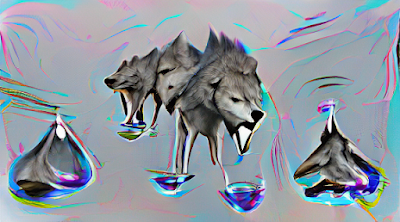
A quick post about an old monster of mine. Remember drop wolves? Well, here’s what they look like.

Drop Wolves

(Or, at least, what a text to image AI thinks they would look like. Although maybe this pic is better for droplet wolves?)

Creative Commons license

This work is licensed under a Creative Commons
Attribution-NonCommercial-ShareAlike 4.0
International

(CC BY-NC-SA 4.0) license.

Tuesday, November 23, 2021

Gems: A Short Series

I’ve been meaning to do another movie review for a while, so obviously it’s time to start a series of posts discussing dungeon treasure stocking instead. Specifically, how to handle gems. It’s inspired by this OD&D forum post that’s been going on for that last month or so.

How do you assign gems to treasure? More specifically, how much information do you include, or should you include? Full description of each gem and quantity, minimum information necessary, or something in between?

I lean towards the minimum, with a few extra details. But before I get into that, I need break down the steps to assigning gem details. Loosely based on the “official” process, the steps are:

  1. Check if there are gems in a treasure cache or trove.
  2. Check the number of gems.
  3. Assign base gem value.
  4. Check how many gems are of higher or lower value.

If randomly assigning treasure, Steps 1 and 2 are handled as part of the treasure table in either Volume II: Monsters & Treasure (page 22) or Volume III: Underworld & Wilderness Adventures (page 7) depending on whether it’s a wilderness treasure or dungeon treasure. Step 3 involves a roll on the Gem Base Value table on page 40 of Monsters & Treasure, followed by a d6 roll for each gem or group of 5 to 10 gems as Step 4.

In the official process, you could argue that there is a fifth step, “Record the info, along with extra details like gem type or color”. But the books do not actually say that all four steps must be done at the same time, before the dungeon key is completed.

I would argue that it’s easier to do Steps 1 through 3, record the info as Step 3.5, and put off the final roll for Step 4 when each gem is appraised.

So here is my suggested gem generation process for GMs stocking treasures:

Step Zero: Pick a Dungeon Theme

Picking a theme is of course is part of the dungeon creation process, rather than the gem generation process, but what kind of dungeon you are creating and where it is should, logically, affect what kind of gems might be available. One trivial example is pearls, usually treated as if they were gems. Underwater treasures or coastal treasures might reasonably include more pearls than someplace far from an ocean. Other gem types could be more or less common depending on the region: if jade is more common in one area, dungeons in that area or connected in some way to that area might have more jade in their treasure troves than other gems.

Step One: Pick Your Gem Types

It’s arguably not immersive to describe gems to players this way:

“You find 30 gems of 100 gp value.”

It’s more immersive to describe them this way:

“You find 20 sapphires and 10 diamonds.”

But it’s crazy to roll for each gem to see what its type is, especially since the average PC probably won’t know the exact type, just the general appearance. The easier method is to assign three gem types to the dungeon as a whole, for example opaque red, murky green, and clear yellow. All gems in that dungeon will be one of those types, simplifying the next step.

Step Two: Check the Number of Gems

As you stock each treasure trove in a dungeon, you make three rolls:

  • How many gems are Gem Type 1?
  • How many gems are Gem Type 2?
  • How many gems are Gem Type 3?

You defined each gem type in Step One, so all you need to roll is a number. Gem Type 1 will be different for each dungeon. There is no table lookup for this step.

Since we can subtract a number from the roll and discard any result of 0 or less, we can fold “Check for Gems” into this step as well.

Step Three: Revealing Details to Players

For reasons I’ll explain more in a future post, each of our gem types has a predefined base value. We actually don’t need to roll any more as part of dungeon key creation. We just need to tell the players “You find 10 gems that look like this, 8 that look like this, and 2 that look like this.” And there’s only three "this"es per dungeon, so players can just keep a running total of each gem type found.

If there’s a dwarf in the party, or someone with gem appraisal skills, they can find out more details, including the exact value. Or they can have the gem appraised, or just sell it blindly without knowing the details.

I plan on detailing each of these modified steps in a separate post, with appropriate tables. I won’t be posting before next week, however.

Series Index

  • Gems Intro (this post)
  • Gems I : Types
  • Gems II: Quantities
  • Gems III: Assessments
(Will edit to add links as the posts are published.)

Creative Commons license

This work is licensed under a Creative Commons
Attribution-NonCommercial-ShareAlike 4.0
International

(CC BY-NC-SA 4.0) license.

Tuesday, November 9, 2021

Marvel Reviews: Eternals

I made my first trip to a movie theater after two years of staying home to watch the new Eternals movie, so I thought I’d give a quick review.

Eternals

Rating: C-

The Eternals movie seems like a good opportunity to mention a modification I may need to make my movie ranking system. (Full explanation of my ranking system is here.) See, I know a lot of people freak out when I rank a movie as C (Average,) because common opinion is that “average” means “bad”. Or if I rank something as C, it means I didn’t like it.

But actually I kind of like Eternals. I will probably watch it again when it hits the streaming services. I just recognize that it’s not really an important film. It’s competently made. Well, mostly competent. I did have to give it a minus for a couple flaws. But there’s really no reason to either recommend or recommend against seeing it. It’s just a movie.

The flaws are that the film drags in places and lacks enthusiasm in others. Plus, one actor issue I’ll mention later. The film really needs to be short or at least move along quicker.

Further thoughts:

  • Too many new main characters for one film, so we really don’t get a feel for any of them.
  • Rather than cut some of the characters, I think this really should have been two movies.
    • First movie focuses on the apparent threat from the Deviants and only involves Ajak, Sersi, Ikaris, Sprite, Gilgamesh, and Thena. It ends with Sersi contacting Arishem.
    • Second movie adds Kingo, Druig, Phastos, and Makkari, and explores more about Kro while also switching to the Emergence plotline.
  • Splitting it into two movies allows us to explore more about Sersi, who seems to be our POV character in the film, but we really don’t get to know her well enough. All of the characters are treated pretty superficially, and only Sprite, Kingo, Phastos and Thena really stand out.
  • Most reviewers, even if they give the movie a thumbs down, say the entire cast does a great job. I have to rewatch the film because I had a very different feeling: I kept thinking the Druig character was a pretty poor performance. Maybe I missed something.

Creative Commons license

This work is licensed under a Creative Commons
Attribution-NonCommercial-ShareAlike 4.0
International

(CC BY-NC-SA 4.0) license.

Thursday, September 23, 2021

Last-Minute d6 Dungeons: Map Glyphs

I’m looking at the Last-Minute d6 Dungeons series (links below) and wanting to simplify it some more… but also, wanting to make it more readable.

Here’s what I mean: I plan on creating customizable dungeon maps that use these techniques. It would help people a lot if I could put an instruction right on the map, so that the GM using it wouldn’t need to turn back to an instructions page. Instead, the introduction would give a couple simple icons and how to interpret them.

Example A: Side Passages

The glyph for this shows three boxes, each representing a d6. The position of each door or doorway along the main corridor is the position of each d6, in order.

Look for the lowest d6 roll first.

  • If it is Odd, the exits start on the North or West side of the corridor.
  • If it is Even, the exits start on the South or East side of the corridor.

If the second or third exits exist, it will be on the same side as the first exit if the d6 that represents it is odd, or the opposite side if the d6 is even.

(There would, of course, be another glyph for tunnels that run vertical on the map instead of horizontal, but I didn’t make one yet. It would look like the above glyph, but rotated 90 degrees.)

Example B: Tunnel Junctions

Same 3d6 roll as for Side Passages, but the position of each d6 is the order of branches or exits clockwise around the compass. (This is what the curved “triangle” represents.)

  • If two of the dice match, the d6 that doesn’t match tells you which direction to skip (left, middle, right.) Branches or exits will be in the other two directions, in clockwise order.
  • If all the dice match, roll another d6 and check the result: 1-2 = turn left, 3-4 = middle or straight, 5-6 = turn right.

In either Example A or Example B, the number of matches tells which table to use to look up the d6 result (loose, doubles, or triples,) as per the Drop Dice Exits post.

Links to Last-Minute d6 Dungeons series:

  1. Tunnels
  2. Tunnels update
  3. Exits
  4. Drop Dice Exits
  5. Side Exits Update

Creative Commons license

This work is licensed under a Creative Commons
Attribution-NonCommercial-ShareAlike 4.0
International

(CC BY-NC-SA 4.0) license.

Monday, September 20, 2021

Ethereal Components

The way I run magic in D&D, M-Us use common, easy-to-get “material components” as spell ingredients during their spell prep (not during spell casting.) This helps explain why there is even a need for spell prep and why it is usually done between adventures rather than during them.

But one particular idea I’ve had about this spell prep is: some spell prep involves using a material object to make a temporary ethereal duplicate of that object that the spell caster “carries” with them, as if it were equipment. Examples of this for 1st level spells:

Hold Portal (object: iron spike)

Casting the spell wedges an invisible spike under the door, preventing the door from moving for a short period of time.

Shield (object: wooden shield)

Summons an invisible shield between the caster and opponents the caster is facing at the time of casting.

Magic Missile (object: arrow)

Summons an invisible arrow or large dart into the caster’s hand that can be thrown immediately at an opponent.

Light (object: lit candle)

When prepped, the light from the candle is “stored” ethereally, attached to whatever is holding the lit candle (M-U’s hand, end of a staff, etc.) When cast, the light becomes visible above the attachment point and moves with it. Max duration = max burn time for a candle.

1st level spells would only be able to bring back one quality of the object used (like the light of a candle, or the obstruction ability of an iron spike.) The object itself would not appear (not a conjuration, in other words,) so you couldn’t use Hold Portal to summon spikes to use as climbing gear, for example. The effect is short-lived.

3rd level spells would allow actual items or material to be stored ethereally and conjured when needed.

Creative Commons license

This work is licensed under a Creative Commons
Attribution-NonCommercial-ShareAlike 4.0
International

(CC BY-NC-SA 4.0) license.

Friday, September 17, 2021

Portable Holes in a One-Plane Universe

There’s a question about portable holes on the OD&D forums: do you treat it as a Bag of Holding, or just a temporary hole? The question assumes in both cases that there’s an extra-dimensional space involved, as mentioned in the Greyhawk supplement.

But I thought: What if there isn’t?

I’ve written before about how I prefer a one-plane cosmology with a material world that has additional states of matter beyond solid, liquid, gas, and plasma. To maintain that, there couldn’t be any extra-dimensional spaces under my cosmology. So where does the hole part of a portable hole come from? Where do things inside the hole go when it is removed?

How I interpret Portable Holes:

  • Turns a ten-foot long cylinder of connected solid material into ethereal matter.
  • The effect stops when it hits liquid, gas, or any other non-solid material and does not continue, even if solid matter resumes before the ten-foot range is reached.
  • Objects or living beings that enter the hole at this point aren’t transformed. They are just normal objects occupying space previously filled with solid matter.
  • When the hole is removed, any ethereal matter tries to return to its solid state. If something is already in the same space and can’t be pushed out, it remains ethereal until that space is no longer occupied.

This means that if someone is crawling through a Portable Hole through a stone wall when the hole is removed, they become embedded in stone. They will suffocate, if they need air to breathe. Meanwhile, there’s an ethereal stone duplicate of them occupying the same position. When they are removed from that position, the stone reappears. If the surrounding stone is no longer there, you wind up with a statue of a crawling person.

There are some other weird situations that could happen, but the general principle is that two solid objects or two ethereal objects can’t occupy the same space at the same time, but a solid object and an ethereal object can occupy the same space.

Creative Commons license

This work is licensed under a Creative Commons
Attribution-NonCommercial-ShareAlike 4.0
International

(CC BY-NC-SA 4.0) license.

Friday, September 10, 2021

Last-Minute d6 Dungeons: Side Exits from Tunnels

Readers may have noticed that the Wednesday installment of the Last-Minute d6 Dungeons (links at end of post) reduced everything down to one (semi-) drop dice method to determining exits, but there was something missing. When rolling for side exits from tunnels, the drop dice method only tells you how far along the tunnel section each exit is, but doesn’t tell you which side of the tunnel it is.

I was aware of this, but left it out for a reason: I wasn’t happy with the methods I came up with. There’s basically four obvious methods of dealing with it.

  1. Roll 1d6 or flip a coin for each exit to determine which side.
  2. Don’t roll again. Just pick the side that makes the most sense (no connecting back to already-mapped areas, for example.)
  3. Make the exit roll do double duty. If d6 result is odd, exit is on North or West side of tunnel, whichever makes sense. If d6 is even, exit is on South or East.
  4. Same as #3, but only for first exit in tunnel section. Second exit will be on the side alternate, and third exit will be on the same side as first exit.

Method #1 adds extra dice rolls, right after we trimmed some out, so it’s no good.

Method #2 is fine as a general principal to modify random results where needed, but the whole point is to make a random generator.

Method #3 is a bit predictable. For example, a loose (no match) d6 result of 1 is a side tunnel, but under this rule, all side tunnels would be on the same side of a tunnel. Method #4 fixes this a little, but still could be more random.

But since we are also rolling dice of different colors (two light-colored, one dark-colored,) we could make use of that to modify Method #4.

  1. If the dark d6 result is odd, the first exit is on the North or West side of the tunnel. If the dark d6 is even, the first exit is on the South or East. Second exit will be on the opposite side, and third exit will be on the same side as the first. Modify any result that would lead back into already-mapped areas.

If we really feel the need for more randomness, flip the second or third exit to the alternate side if the d6 result is the “opposite” of the dark d6. In other words, if the dark d6 is even but the d6 for the 2nd exit is odd, that exit is on the same side of the tunnel as the first exit.

Links to Last-Minute d6 Dungeons series:

  1. Tunnels
  2. Tunnels update
  3. Exits
  4. Drop Dice Exits

Creative Commons license

This work is licensed under a Creative Commons
Attribution-NonCommercial-ShareAlike 4.0
International

(CC BY-NC-SA 4.0) license.

Wednesday, September 8, 2021

Last-Minute d6 Dungeons: Drop Dice Version

I did some testing for the Last-Minute d6 Dungeons series (d6 Dungeons 1, d6 Dungeons 2, and d6 Dungeons 3,) and decided the ratio of rooms to tunnels was too low (Oops! All tunnels!) The problem is the Side Exits roll, which works fine in its original iteration for the semi-random dungeons pamphlets, but that is because that version only has a 42% chance of at least one tunnel, instead of a 97% chance.

One solution would be to replace the Side Exits roll with the Exit Destination roll, but treat it as a freeform drop-dice roll.

  1. Roll 3d6 for each tunnel.
  2. The position of each d6 is the position of each door or doorway (read left to right as West to East for horizontal tunnels, North to South for vertical tunnels.)
  3. For dice that match, only use the position of the first d6.
  4. Read the d6 result from the appropriate Exits subtable below, depending on whether its a triple, a double, or a loose d6 with no match.
d6 Loose d6 Result
1 Simple Corridor
2 Minor Debris
3 Missing Ceiling/Floor
4 Well or Fountain
5 Staircase or Ladder
6 Statue/Monument
d6 Doubles Result
1 Animal Pens
2 Storage (roll 1d6 again)
3 Jail Cell(s)
4 Food Prep
5 Living Area
6 Guard Station
d6 Triples Result
1 Armory (Weapons/Armor)
2 Execution Chamber
3 Temple or Shrine
4 Forge
5 Library
6 Magical Lab

In some cases, the GM could improvise a second roll to specify the variants. The only example specifically referenced on the table is “Storage”, where another d6 is rolled and the same table read again as a clue to what is stored in that room. Similarly, a well or a fountain could be dry or full of fresh, stagnant or poisoned water, or acid (2d6 reaction roll, with Dry as the middle result.)

This same Exits roll could replace the Tunnel Turns roll, but using two light-colored dice and one dark.

  • If no dice match, each position represents one of the three direction (left, right, straight ahead.)
  • If only two dice match, read the dark d6 first to find out which direction is blocked.
    • First Position: No door or passage North in a horizontal West/East tunnel, No door or passage West in a vertical North/South tunnel.
    • Second Position: No door or passage straight ahead.
    • Third Position: No door or passage South in a horizontal West/East tunnel, No door or passage East in a vertical North/South tunnel.
  • If all three dice match, read the dark d6 as the direction to use (First Position = North or West, etc.)

Inside rooms, roll 3d6 for exits in the same way.

Creative Commons license

This work is licensed under a Creative Commons
Attribution-NonCommercial-ShareAlike 4.0
International

(CC BY-NC-SA 4.0) license.